
Introduction
The petroleum equalisation fund has an crucially in ensuring integrity and fairness in the chain of supply of fuel. While a lot of people focus on the fluctuation of fuel prices in the fuel pump, fewer know the financial mechanisms that work behind the behind the scenes to ensure that petroleum products are accessible across various regions with relatively constant prices.
In countries that heavily rely on the road network and distribution of fuel, delivering fuel to remote areas often is much more expensive than the supply of urban areas near ports or refineries. Without an equalisation mechanism the people living in remote regions could be paying significantly more in the purchase of the same gasoline. Petroleum equalisation funds tackles this issue by assisting in balancing transport costs and ensuring an even pricing structure.
As the market for energy evolves in 2026, debates on the cost of fuel and deregulation, sustainability and economic efficiency have made fuel equalisation program more important than ever before. Knowing how it operates can assist policymakers, businesses as well as everyday consumers get a better understanding of the price of fuel and energy policies of the government.
What Is a Petroleum Equalisation Fund?
The petroleum equalisation fund is an investment mechanism that is designed to eliminate differences in the cost of distribution of fuel across geographical locations. As opposed to allowing transport costs to cause significant regional price variations The fund compensates or compensates distributors and marketers for the approved logistics expenses.
The principal goal is to guarantee that the consumers pay comparatively the same prices for petroleum products no matter where they reside as long as the pricing policies of the government allow for this level of equalisation.
The notion does not need to include directly fuel subsidies. Instead, it concentrates on balancing the distribution costs caused by the different distances between locations, infrastructure limitations or the transportation method.
Why Was the Petroleum Equalisation Fund Created?
The distribution of fuel networks are not always the same. Cities in the coastal zone that are close to refineries or import terminals generally have lower transport costs than remote and inland cities.
In the absence of an equalisation mechanism distributors who serve areas that aren’t served would either take on more expenses or pass the costs on to consumers. This could result in economic inequality and deter investment in the less-served regions.
The fund for equalisation of petroleum was created to meet a variety of significant goals:
- Create relatively uniform pricing for fuel across regions.
- Encourage nationwide fuel availability
- Help to ensure economic inclusion of remote communities
- Reduce regional price distortions
- Strengthen energy distribution networks
These goals help governments keep their balance of economic and social while also ensuring that everyone has access to the most essential fuels.
How Does the Petroleum Equalisation Fund Work?
While the implementation process varies between countries however, the fundamental process is the same.
The fuel marketers transport petroleum products from authorized supply points to depots or retail stores. The actual cost of transportation is recorded and verified according to established guidelines. If the reimbursement is eligible, they are derived from the fund for petroleum equalisation to cover eligible logistics costs.
This creates the creation of a pricing structure where transport costs are spread more evenly instead of being entirely borne by those living in remote areas.
Simplified Process
| Stage | Description |
|---|---|
| Fuel procurement | Petroleum products are extracted through refineries or import terminals. |
| Distribution | Fuel is delivered to storage depots, as well as retail outlets. |
| Cost assessment | Logistics and transportation costs are calculated based on the rules applicable to them. |
| Verification | Authorities examine documents supporting eligibility and documentation. |
| Reimbursement | The funds for approved claims can be repaid through the fund for petroleum equalisation. |
| Consumer impact | Cost differences between regional fuels can be lowered through cost balance. |
Main Objectives of the Petroleum Equalisation Fund
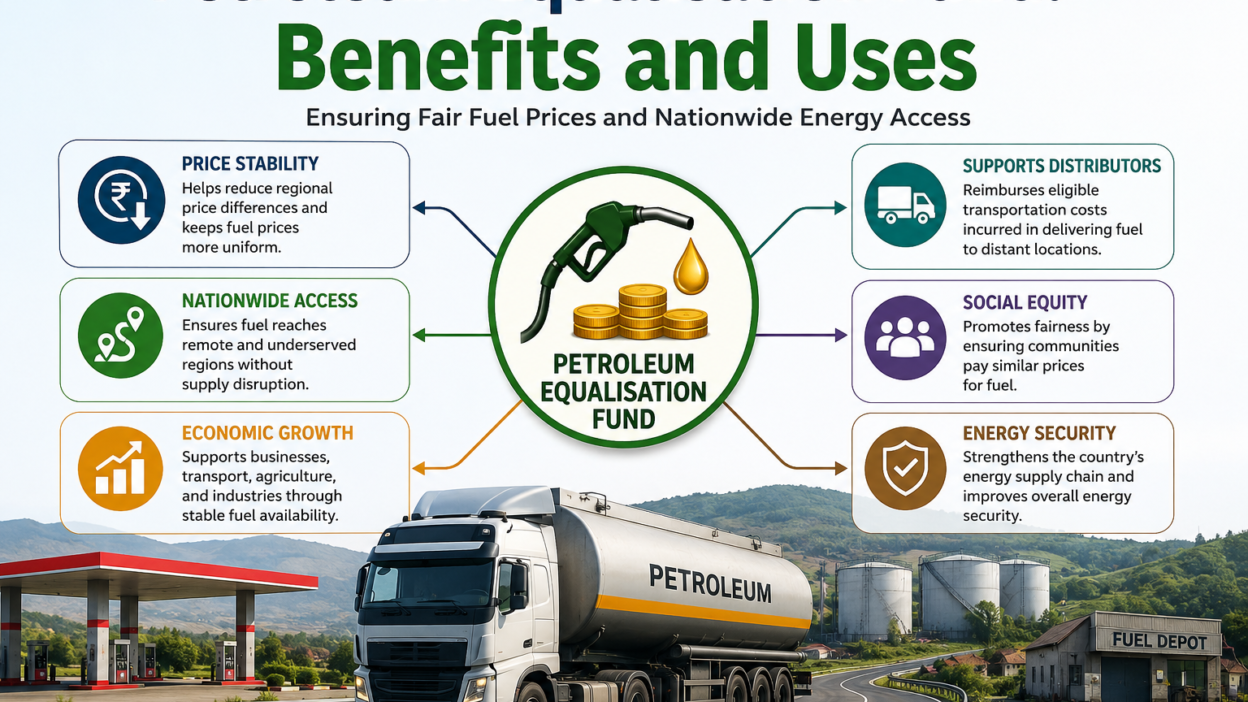
The petroleum equalisation fund is used to achieve many economic and policy objectives in addition to reducing the cost of transport.
Price Stability
One of its prominent objectives is to minimize the excessive regional differences in fuel prices due to logistics, not fundamental market factors.
National Energy Access
Areas that are far from refining facilities require regular fuel supplies for healthcare, transportation as well as agriculture and industry. Equalisation encourages distributors and retailers to continue servicing these regions.
Economic Development
Companies operating from remote areas require stable fuel prices to stay competitive. The certainty of pricing helps invest and job creation.
Market Confidence
In reducing the burden of transportation that is unpredictable government officials can increase confidence in fuel marketers as well as logisticians.
Social Equity
People who live outside of major cities can get access to essential fuels and not have to bear disproportionate transport costs.
Why Fuel Transportation Costs Matter
Distribution of petroleum is costly. The costs can include road transportation pipeline operations, pipeline operation maritime shipping storage, insurance security, handling costs and maintenance of infrastructure.
Remote regions are often faced with additional issues, including bad road conditions, long travel distances and limited storage facilities. These issues increase the cost of operations which ultimately affect retail prices for fuel.
The Petroleum Equalisation Fund aids in reducing the impact these inevitable inconsistencies.
Benefits of the Petroleum Equalisation Fund
If properly managed If properly managed, the petroleum equalisation funds provides significant benefits.
Improved Regional Fairness
Consumers from all over the world have better pricing and help to prevent geographical disadvantages.
Better Fuel Availability
Distributors are more likely to serve less profitable areas in cases where the cost of transportation can be partially recouped.
Economic Stability
Businesses that depend on gasoline, diesel, or other petroleum products profit from lower regional cost volatility.
Support for Agriculture and Industry
Logistics companies, as well as public transport operators rely heavily on the availability of fuel. The stability of prices helps their long-term plans.
National Integration
A uniform access to energy resources enhances the economic participation of the country, rather than concentration of benefits on urban centers.
Potential Challenges and Criticisms
In spite of its advantages however, this fund for petroleum equality isn’t free of controversy.
The reimbursement system could become complex administratively and require strict oversight to ensure that they are not misused. In the event of delayed payments, they could cause cash flow issues for businesses, and insufficient transparency can undermine trust in the public.
Some economists have also suggested that artificially reducing regional price differentials could weaken the incentive for improvement in infrastructure and market competitiveness.
Other issues that are frequently discussed include the pressure on budgets as well as verification issues, and changes in energy policies as countries shift to cleaner energy sources.
Petroleum Equalisation Fund and Fuel Price Deregulation
Numerous countries have considered deregulation of the fuel market, which allows the prices of fuel to be influenced by market conditions instead of government-imposed restrictions.
In a climate that is not regulated the role of the petroleum equalisation fund could change instead of disappearing. The government could narrow its scope and alter the reimbursement formulas or even eliminate specific functions while providing an important role in remote distribution.
The balance between competition from the market and social security remains an important policy issue.
Transparency and Accountability
In order for any system of equalisation to be successful it is vital to be transparent.
Authorities should ensure clear guidelines for reimbursement, release financial reports as needed regularly, conduct audits on a regular basis, and establish electronic monitoring systems to minimize the risk of fraud.
The stakeholders, including the regulators, fuel marketers as well as consumers and policymakers gain when the operations of a fund are well-documented and predictable.
The Role of Technology in 2026
Digital transformation is transforming global petroleum logistics.
Modern technology has the potential to improve the the administration of the petroleum equalisation fund by:
- GPS tracking of shipment
- Electronic documentation
- Automated reimbursement processing
- Data analytics for fraud detection
- Systems for integrated logistics management
AI and analytics that are predictive aid in estimating transportation costs and optimize routes for fuel distribution and improve the efficiency of operations.
Global Perspectives
Different countries take different methods of fuel equalisation based on their specific economic structure geography, energy, and policies.
Certain countries rely heavily on market pricing, with no intervention from the government, whereas others have comprehensive equalisation or subsidy system to protect consumers and ensure universal access to fuel.
There isn’t an ideal model that can be used for all situations. The success of implementation is contingent on the local environment and capacity for fiscal infrastructure quality, fiscal capacity and priorities for policy.
Environmental Considerations
As governments seek greener energy alternatives, funds for petroleum equalisation could come under increased examination.
They argue that the same access to fuel is vital during the transition particularly in regions in which renewable infrastructure is not as developed.
Others are in favor of gradually shifting resources towards the electric vehicle, sustainable transport and more sustainable energy sources with a focus on crucial fuel distribution.
The future will likely involve the balance of energy security and the environment’s accountability.
Common Misconceptions
Many people don’t understand the goal of the fund for petroleum equalisation.
It is often believed that it is merely a way to lower the cost of fuel for all. In reality, its main purpose is usually to decrease the disparities in transportation costs instead of providing universal subsidies for the consumption of fuel.
Another myth is that equalisation negates market forces. Although it could impact pricing structures, larger elements like the global crude oil price and tax rates, exchange rates, refinery capacity, and supply disruptions continue to are key factors.
Who benefits Who Benefits from Petroleum Equalisation Fund?
The effects are felt across a variety of sectors.
Consumers gain from a more stable pricing for fuel.
Fuel marketers receive support serving markets that are located far away.
Companies can predict better the cost of the cost of operating and transportation.
Farmers rely on steady diesel costs for their harvesting and planting seasons.
The public transportation system may be able to enjoy improved operational stability as regional price differences are diminished.
In the end, a balanced distribution of fuel helps to build economic resilience.
Future Outlook
The fund for petroleum equalisation will remain in flux as governments adjust to the changing landscape of energy.
The major trends that will shape its future include increased digitization, enhanced transparency requirements, modernization of infrastructure as well as fiscal reforms. gradually integrating renewable policies for energy.
Instead of disappearing completely the concept of equalisation is expected by many experts to evolve into mechanisms to become more precise focused, data-driven, and accountable.
As nations strive to ensure energy security, while promoting market efficiency, properly designed equalisation policies can be crucial to balance regional requirements.
Conclusion
The fund for petroleum equalisation is much more than a mere payment system for financial expenses. It is a political instrument created to ensure an equitable distribution of fuel, decrease regional cost disparities, and encourage broad economic participation.
By helping offset transportation-related price differences, the fund encourages suppliers to reach remote communities while providing consumers with greater pricing consistency. However the effectiveness of governance as well as transparency and modernization are vital to ensure sustainability over time.
In 2026, as the energy markets continue to change and evolve, oil equalisation is an important subject for businesses, governments and individuals who want to know how the fuel is distributed to all corners of the country and why distribution costs are crucial equally as the production costs.
Frequently Asked Questions
1. What is the Petroleum Equalisation Fund to you in a simple way?
The fund for petroleum equalization an investment system that can help to balance the costs of transportation for distribution of fuel, which allows the prices to be more constant across regions.
2. Does the petroleum equalisation fund directly help to subsidize the cost of fuel?
Not necessarily. In many instances it focuses on reimbursement of eligible distribution costs, rather than giving directly to consumers with subsidies.
3. What makes an oil equalisation fund crucial?
It encourages fair pricing of fuel it supports widespread availability and encourages distribution to areas in remote regions and reduces regional disparities in economics.
4. Are fuel prices likely to change even if a petroleum equalisation fund exists?
Yes. Prices for global oil and exchange rates, taxes refining expenses, and market conditions will continue to influence retail prices for fuel, even if an equalization process is set in place.
5. What’s the future for the funds for petroleum equalisation?
Many experts believe that these funds will to become more transparent, tech driven, and focused in adjusting to market deregulation and the continuous shift towards more sustainable energy systems.