
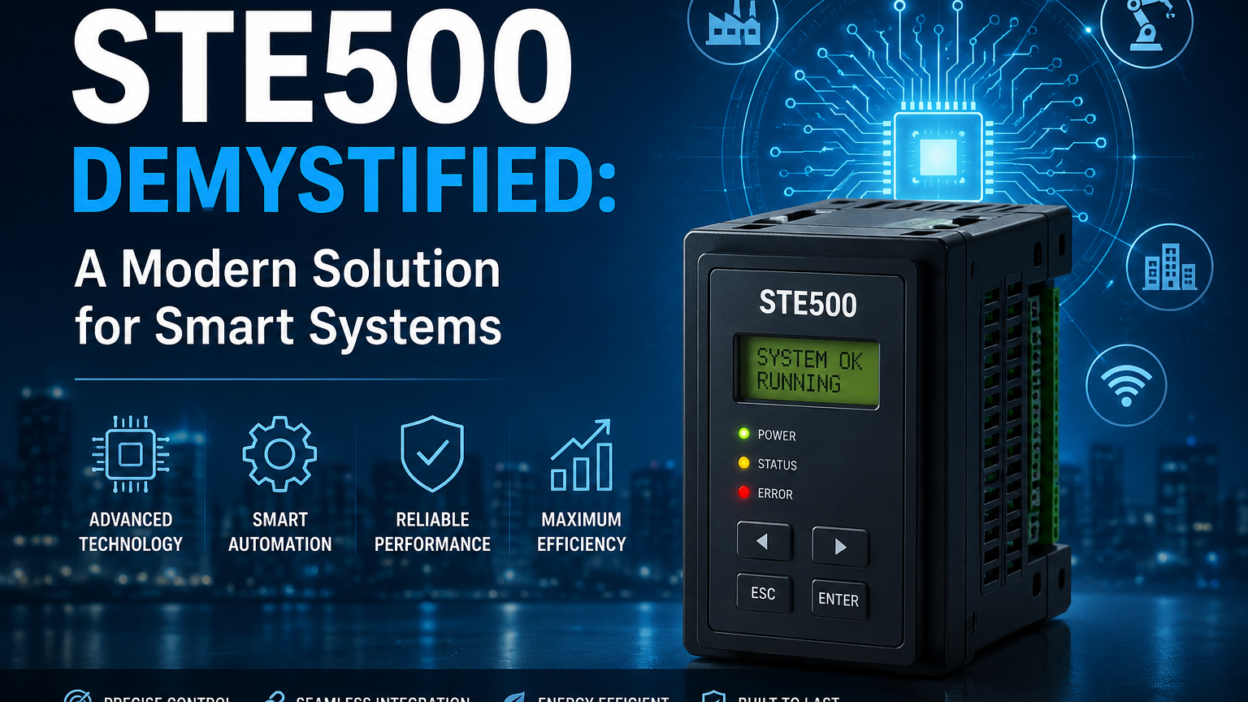
Introduction to STE500
The STE500 is now a widely talked about term in the world of the world of modern technology and industrial systems particularly in 2026 when efficiency as well as automation and smart control systems dominate the global market. It can be used in monitoring environments, engineering systems, or in advanced operational systems The STE500 is a class of reliable technology driven by performance to enhance control, precision efficiency, and control.
In simple words it is simply put, the the STE500 is widely regarded as a high-efficiency module that is used to improve efficiency and improve the accuracy of technical processes in a variety of different applications. As the world of business continues to change and evolve, the demand for solutions such as the STE500 is increasing as companies are seeking out more efficient and faster, as well as more robust solutions. This guide explains everything about STE500 in greater detail and covers its design, function and applications, as well as its benefits and the reasons why it will be the preferred option in 2026.
Understanding STE500 and Its Core Purpose
The ST500 is typically linked to sophisticated controls or processors that are designed to manage difficult tasks with accuracy and stability. The primary goal of the system is to streamline tasks that typically required manual effort or less efficient systems.
In its beginning, STE500 technology is designed to provide:
- High efficiency of operation
- Consistent performance under load
- New automation capabilities
- System errors are reduced
- Process control
What is what makes STE500 so valuable in contemporary situations is its ability to adapt. It can be incorporated into various industries where reliability and accuracy are crucial, like manufacturing automation platforms, control frameworks and even technical infrastructure configurations.
As digital transformation speeds up the need for systems such as STE500 can no longer be optional. They become essential elements of the competitive business operations.
Key Features of STE500 Technology
The main strength of STE500 is in the combination of cutting-edge engineering and practical. Here are a few of its best-known attributes explained in a systematic way:
High-Speed Processing Capability
STE500 system is designed so that it can manage operations quickly and efficiently, thus reducing the time to complete operations and enhancing real-time performance.
Stability Under Heavy Load
One of the most notable aspects is its ability to provide an even output in high-demand environments.
Advanced Compatibility
STE500 can be integrated with multiple platforms system, platforms, and industrial configurations without needing massive modifications.
Energy Efficiency
Newer models of STE500 are engineered to help reduce energy use while maintaining the performance level.
Precision Control Mechanism
It is highly precise in its control functions, which makes it ideal for situations where even minor mistakes can cause major problems.
Durability and Long-Term Use
With durable materials and engineering standards STE500 Systems are built for long-term, operational use.
Technical Overview of STE500 (Simplified Table)
To understand better how STE500 is performing in real-world settings The following table offers an easy description of its most important aspects:
| Feature Category | Description | Practical Benefit |
|---|---|---|
| Processing Speed | Rapid execution of orders and operations | Improves efficiency and reduces delays |
| System Stability | Maintains consistent performance under load | This ensures that the operation is uninterrupted |
| Integration Ability | Works with a variety of platforms and systems. | It is easy to deploy in various industries. |
| Energy Consumption | Optimized for low power use | Reduces operating costs |
| Precision Control | High-level accuracy of execution | Improves accuracy and reduces errors. |
| Durability | Quality build for use over a long period of time | Reduces the cost of maintenance and replacement |
How STE500 Works in Real-World Environments
The mechanism that operates STE500 is dependent on its integration into an overall system. Once installed, it operates as a central module that stores information, handles commands, or manages operations based on the configuration.
In industrial settings, STE500 typically performs the following functions:
- The system collects and processes input signals
- Examines operational information in real-time
- Performs command commands with the utmost precision
- Communicates with connected devices and systems.
- Stable operation across different processes
This layering of functionality makes sure that the operation runs smoothly with no disruptions even within the most complex environments.
The flexibility of STE500 lets it function in both large and small-scale systems, which makes it an ideal solution for today’s industries.
Applications of STE500 Across Industries
The Ste500 does not limit itself to just one field. Its modular design lets it be utilized across a wide range of sectors in which the need for automation as well as control is crucial.
Industrial Automation
In manufacturing facilities, STE500 is often used to regulate machinery, monitor processes, and guarantee quality of production.
Energy and Power Systems
It assists in monitoring and regulating of energy systems. It assists to ensure stability and effectiveness in the distribution of power.
Smart Infrastructure
STE500 is a key component in smart building systems where it aids in controlling temperatures, lighting, as well as operational efficiency.
Data and Monitoring Systems
It is employed in settings that require real-time monitors and accurate handling of data are essential.
Transportation Systems
In modern network of transport, STE500 aids in operational coherence and reliability of the system.
Key Benefits of STE500 Systems
The increasing popularity of STE500 is due to its advantages in practical use. This makes it the preferred choice for numerous technical setups.
Improved Efficiency
STE500 reduces manual work and boosts automation, which results in quicker processes.
Cost Reduction
By reducing energy consumption and maintenance it reduces operating expenses.
Enhanced Accuracy
The precision control minimizes the chance of the chance of errors and increases reliability.
Scalability
STE500 is a suitable choice for both small as well as large industrial infrastructures.
Long-Term Stability
Its durable design ensures consistent performance over extended periods.
Easy Integration
It is possible to integrate it into existing systems with no major changes.
STE500 vs Traditional Systems
Knowing how STE500 compares to other systems can help highlight its benefits more than.
| Aspect | STE500 System | Traditional Systems |
|---|---|---|
| Speed | High-speed automated processing | The slower semi-automated or manual versions are slower. |
| Accuracy | High-precision control | Moderately accurate |
| Energy Efficiency | Optimized to reduce consumption | Higher energy usage |
| Maintenance | Low maintenance requirements | Maintenance needs to be performed regularly |
| Scalability | Highly adaptable | Limited scalability |
| Integration | Integration of the system is simple | Oft, it is a intricate integration |
This example clearly demonstrates the reason why industries of today are moving toward STE500-based systems.
Installation and Operational Considerations
A proper implementation of STE500 is crucial to ensure maximum performance. While the method of installation will vary based on the type of system but the basic process is a structured configuration and compatibility check.
The most important considerations are:
- Verifying compatibility with the system prior to installation
- A proper calibration is essential for an accurate performance.
- Regular system diagnostics after deployment
- Stable environmental conditions
- Follow the manufacturer’s or technical instructions
When installed correctly, STE500 requires minimal intervention It is therefore a reliable long-term solution.
Maintenance and Performance Optimization
To ensure optimal functionality, STE500 systems should be frequently monitored and updated when necessary. Preventive maintenance helps ensure long-term stability.
Simple maintenance strategies include:
- Regularly scheduled performance inspections
- Inspection of the system and cleaning
- Updates to firmware or software (if necessary)
- Monitoring the energy efficiency levels
- Identifying the early indications of system wear
These methods help prolong the life span of the system, while ensuring the same quality of output.
Future of STE500 Technology in 2026 and Beyond
As the world moves further into automation and intelligent technologies, STE500 technology is expected to further develop. Future enhancements could be focused on:
- AI integration has been enhanced AI integration
- More efficient use of energy
- Better real-time analytics
- Security features that are stronger
- Modular flexibility is increased.
The need for systems such as STE500 continues to rise because companies are focusing on efficiency as well as automation and data-driven decision-making.
Short List: Why STE500 Is Widely Used
- Reliable performance in demanding environments
- High compatibility with current systems
- Lower operational costs over time
- Control accuracy and precision with high precision
- Multi-industry scalable
Conclusion
The Ste500 is an outstanding example of a robust and adaptable product that is designed to meet the demands of the demands of modern technology and industrial processes. The combination of stability, speed as well as precision and effectiveness can be a great asset in all sectors. As businesses continue to adopt newer and more efficient systems in the year 2026 STE500 technology can play a important role in increasing productivity and reducing the complexity of operations.
In everything from industrial automation, to intelligent infrastructure the applications of STE500 are broad and significant. With constant advances and increasing demand for STE500, the STE500 will continue to be an essential component of the future-ready system in the years to come.
Frequently Asked Questions (FAQs)
1. What exactly is STE500 employed to do?
STE500 is utilized in various industrial and technical equipment to improve the accuracy of control, automation, and efficiency of operations.
2. Are STE500 appropriate to be used in industrial automation?
It is true that STE500 can be found in a variety of industrial automation equipment because of its reliability, speed and control precision capabilities.
3. What is it that makes STE500 different from conventional systems?
STE500 provides greater efficiency, higher scaling, less energy use and better accuracy when compared to conventional systems.
4. Does STE500 require regular maintenance?
It is not necessary to maintain the system however, periodic system checks can to ensure long-term stability and performance.
5. Are there ways that STE500 can be integrated with existing systems?
Absolutely, STE500 is designed for seamless integration with current infrastructures and the existing ones without major changes.