Droven IO the future of technological advancement USA will be more than just a search term. It is a reflection of a growing demand for clear, useful and affluent information on how technology is transforming our American economy. In everything from cybersecurity and cloud-based infrastructure to automated the development of software, data centres semiconductors, digital transformation as well as the future of employment in the United States is entering a stage that makes technology not just a function to be performed. It is the cornerstone of productivity, competitiveness security and long-term development.
Droven.io describes itself as a technology-focused editorial platform that covers digital transformation software development cybersecurity data, future projects, technology for enterprise and topics of innovation for readers who are looking for clear and logical advice rather than a haze of technical jargon. The site’s website highlights specific categories including cybersecurity, information technology, privacy issues, news about technology as well as future tech developing software, development of websites cloud computing Big Data, tools for productivity and content that is focused on innovation.
What Does Droven IO Future Technology USA Mean?
In the simplest sense, drivenn io future technology usa is referring to how the modern digital technology is transforming American industries, businesses jobs, careers, and every day life. It’s not only about technology or trends. It’s about a larger shift towards more efficient infrastructure, faster software, safe digital operations, automated workflows robust supply chains, and practical innovations.
The term also conveys the common desire of users People want to know what technology is important to them in America. United States, how they impact businesses, and what steps to take next. Startup founders may look for it in order to comprehend the opportunities in the market. A student could seek it out to select the most secure career path for them. Business owners can search for it in order to decide if the modernization of cloud infrastructure, security enhancements or workflow automation needs to be first.
In this sense, Droven.io acts as a helpful reference because it is a source of information on the future of technological advancements, digital transformation, technology news cloud computing, software, and business innovations. The technology news section covers the latest news about USA startups devices, Silicon Valley updates, and how technology will impact global innovations.
Why Future Technology in the USA Matters More in 2026
It is believed that the American technology landscape by 2026 is characterized by a single fact companies are moving from experimentation to implementation. Businesses are no longer interested in technology that is amazing in a demonstration but is a failure in real-world operational processes. They are looking for tangible outcomes, more secure and lower friction, a better customer service and systems that are able to grow without breaking.
This is the reason why the next technology debate in the USA is now focused on the actual implementation. Cloud platforms must support real workloads. Automation should make it easier to save time. Cybersecurity should protect teams that are distributed. Data systems should help the leaders to make quicker decisions. Software teams have to provide services more consistently. Infrastructure needs to be robust enough to handle industries like healthcare, logistics manufacturing finance, education, and public service.
Technology policy at the federal level has a bearing on. CHIPS for America continues to assist in semiconductor manufacturing, research and resilience of supply chains with announcements for 2026 including deals and awards that are that are tied to silicon-carbide semiconductors high-tech materials research, indium-phosphide production and capacity for manufacturing in the United States. This indicates that technology of the future isn’t just a private sector race. It’s also a national problem of competitiveness.
The Main Technologies Shaping the USA’s Digital Future
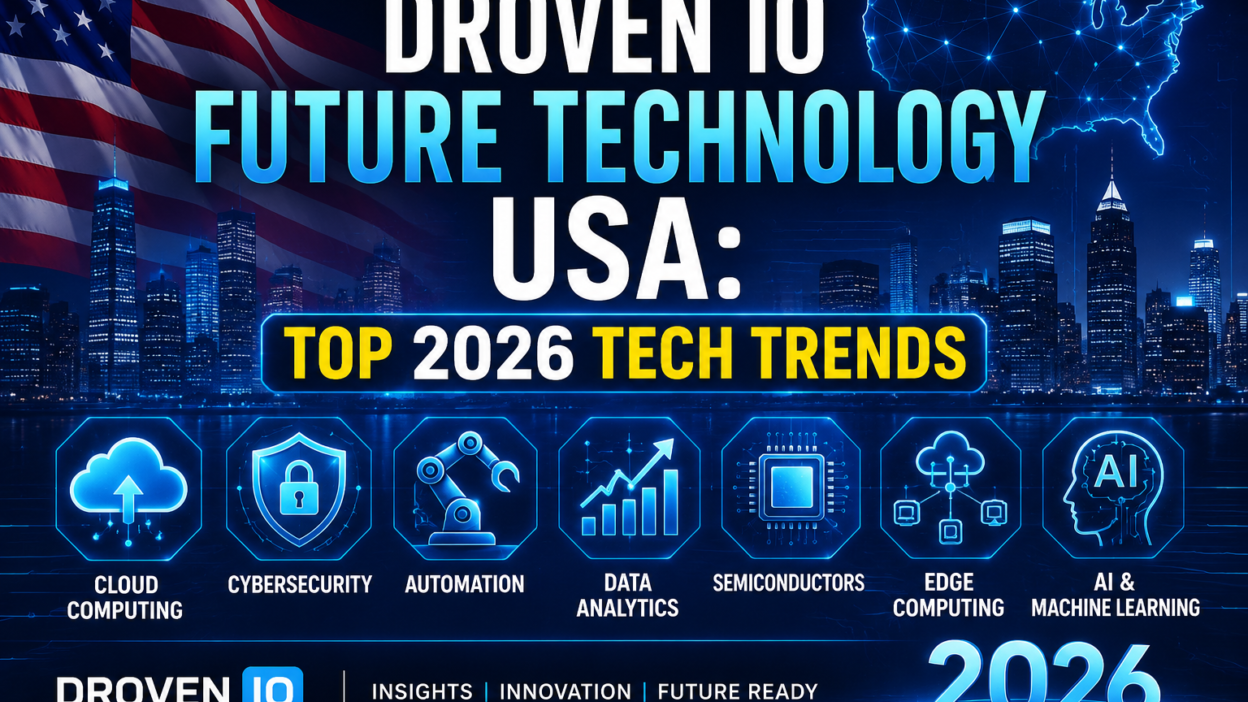
The future of technological advancement in United States is not one single innovation. It’s a connected ecosystem. Cloud computing cybersecurity, data analytics, cyber security edge computing, automation robotics, advanced chips and even software engineering work together to support each other.
Cloud infrastructure offers companies the flexibility. Cybersecurity helps protect digital assets. Data analytics transforms raw data into better choices. Automation reduces repetitive work. Edge computing allows processing to be closer to the devices and users. Semiconductors power almost all modern systems. The software development process connects each these components into useful products.
Droven.io’s digital transformation section is a showcase of data, automation and technologically driven change across different industries across the USA This is in line with how businesses are taking modernization seriously: not as a singular project, but rather as an ongoing business practice.
| Technology Area | Why It Matters in the USA | Practical Business Impact |
|---|---|---|
| Cloud computing | Supports an infrastructure that is scalable remote teams, remote infrastructure, and digital services | Lower infrastructure friction, faster deployment, flexible growth |
| Cybersecurity | Secures data, systems identity, the confidence of the customer | Lower risk of breach, more compliance, and better resilience |
| Automation | Eliminates repetitive manual tasks from everyday tasks | More efficient teams, quicker workflows, and less operating waste |
| Data analytics | Aids leaders to understand their customers, performance and the risk | Better decisions, improved forecasting, stronger personalization |
| Semiconductors | Servers, power devices networks, vehicles and industrial systems | Supply chains that are stronger and more sophisticated products resilience of the nation |
| Edge computing | Processing information that is close to the devices connected to it and the users | More reliable, lower latency and improved real-time performance |
| Software development | Transforms ideas in technology into useful platforms and services | Faster innovation, better customer experience, stronger differentiation |
Cloud Computing as the Backbone of Future Technology
Cloud computing remains among the primary components of drivenn io’s future technology usa since it can support the majority of other things. The latest applications, online stores dashboards for analytics, customer portals remote work tools and other connected devices rely a lot heavily on the cloud’s infrastructure.
For American firms, the main benefit of cloud computing is not storage. It’s ability. An organization can introduce an innovative service, try out features of its products, help remote employees, process huge databases and recover from outages more quickly than using older infrastructure models. Cloud-based systems make smaller companies able to gain access to technology features that were once reserved only for big corporations.
The next stage of cloud adoption will be more controlled. Companies are focusing on the control of costs as well as data management security, uptime, and vendor strategies. Many companies are moving to multi-cloud and hybrid cloud models due to the fact that they want to be flexible without being dependent on a single vendor. This is particularly important in industries that are regulated, such as banking, healthcare and insurance, defense government contracting, and education.
Cloud success in 2026 will depend on the architecture of the cloud, not just hype. Businesses require clean data flows and clear access control and solid backup policies and quantifiable performance targets. An unplanned cloud migration could lead to confusion and result in cost overruns. An effective cloud plan will be the basis for any major technological improvement.
Cybersecurity Is Now a Business Growth Requirement
Cybersecurity is no longer just the responsibility of a technical department. It’s a boardroom problem and a concern for trust among customers as well as a continuity of business problem. As businesses increasingly rely in digital channels, each login device, device, vendor application and data connection becomes part of the risk-management landscape.
This NIST Cybersecurity Framework 2.0 is particularly relevant since it is designed to assist organizations regardless of size, sector or maturity level to understand the importance of assessing, prioritizing, and communicate their cybersecurity initiatives. It also emphasizes governance along with protecting, identifying, detect, restore, and respond functions.
For companies that are in the business of cybersecurity, it is essential to be treated the same way as finance and operations. Leaders must have guidelines, accountability, training vendor reviews and plans for incident response and periodic testing. If a company does not wait until after an attack to consider security is already at a disadvantage.
In the USA cybersecurity will become increasingly important as companies use connected devices cloud platforms remote collaboration tools payments via online systems as well as automated workflows. The more secure the digital environment is the more valuable it is to hackers. Companies that are successful over the long-term will be ones who make security a part of their everyday operations, instead of merely treating it as an expense for emergencies.
Automation and Workflow Modernization
Automation is among the most practical aspects of the future because it addresses everyday business challenges. Automation helps businesses reduce manual labor, accelerate repetitive tasks, increase efficiency, and allow employees time to concentrate on their work.
In the case of a small business Automation could refer to connecting forms on websites directly to an automated Customer Relationship Management System. In a logistics business it could mean automatically updating statuses of shipment. For healthcare facilities, this might be a way of reducing the amount of administrative paperwork. For finance departments, this might be faster reporting and more effective surveillance of fraud. Retail, for instance, it could include inventory alerts or customized customer communications.
The most effective automation doesn’t substitute for judgement. It eliminates friction that is unnecessary. A well-designed workflow will help people become more efficient, not confused. It is essential to have clean processes before adding new tools. If a company automatizes an unworkable process this will make the issue move quicker.
An effective automation plan typically is based on repeated tasks, clearly defined rules that are measurable in terms of time loss and a low risk of operational risk. After these areas have been enhanced, businesses can move towards more advanced workflow management across departments.
Data Centers, Chips, and America’s Infrastructure Advantage
Every digital service is dependent on the physical infrastructure. Behind every application and website, platform and connected device, are processors, data centers networks, memory systems, networks storage equipment, cooling systems, power supply, and other special components.
This is why investment in semiconductors is essential to the development of technological advancement in USA. Chips aren’t just used for computers. They are utilized in vehicles as well as industrial equipment, medical devices smartphones defense systems and energy infrastructures cloud servers, and consumer electronic gadgets.
Federal investment in CHIPS for America shows how crucial the capabilities of our semiconductors in the United States has grown. In June 2026 the Department of Commerce announced multiple agreements and funding initiatives that are related to research in semiconductors, materials discovery and capacity for production. These efforts are crucial because the US’s future in technology is not solely dependent on the development of software, however, it also depends on its capacity to produce and secure crucial chain of supply for semiconductors.
The data centers have also become an important strategic asset. As businesses generate more data and rely on real-time digital services need for secure computing infrastructure continues to increase. Next-generation data centers have to be more efficient in energy use secure, secure, and well-designed, and resilient geographically to handle the demands of demanding work.
Edge Computing and Real-Time Digital Experiences
Edge computing is increasingly crucial because not all tasks requires a remote data center. Certain systems require quick responses close to the place where data is generated. This is particularly relevant for manufacturing floors Smart transportation and healthcare monitoring and operations in retail, logistics system, connected cars as well as industrial machinery.
For instance an industrial sensor that detects a malfunction in equipment can’t always be waiting for information to move between distant systems. Retail stores using smart checkout technology requires speedy local processing. A device in a hospital that monitors patients’ conditions requires high reliability and low latency.
Edge computing is not a replacement for cloud computing. It expands cloud computing. The cloud is still beneficial for coordination, storage with large-scale analysis and management. Edge systems can handle immediate local requirements. Together, they provide an increasingly responsive digital environment.
For companies, the most important question isn’t whether edge computing is futuristic or not. The question is how the faster local processing technology can enhance the safety, reliability, and customer experience or operational performance.
Software Development Will Define Competitive Advantage
Software is the component that converts technology into value that can be used. An organization can invest in cloud-based infrastructure, platforms for data or automation equipment, however without a strong design for software the investments won’t be able to provide a seamless employee or customer experience.
In the USA the United States, software development is moving towards faster delivery, better security as well as a better user experience and a more modular structure. Companies want software that can be easily connected to other systems, be updated rapidly, and scale up without costly rebuilds.
This is the reason applications APIs for programming, platforms with low code practices for DevOps, automated testing, secure programming, and continuous delivery are important. They assist teams to build quicker and reduce the chance of making errors. They help businesses to adjust when their customers’ expectations shift.
The future belongs to companies who treat software as a fundamental business asset. Even businesses outside of the traditional technology industry depend on software to handle orders, assist customers, monitor trends as well as train employees, schedule services, and help with day-to-day activities.
The Future of Work in the USA
The technology of the future is altering the way people work. Remote collaboration and digital project management automatic reporting systems, online learning, and cloud-based solutions have already changed how we work. The next step is improving productivity at work and efficient, not just being more digital.
Employees don’t need any additional tools to create noise. They require systems that minimize confusion, make information more organized and help them make better decisions. Companies must design their technologies that are based on real human workflows. This means less disconnected platforms, more efficient onboarding, more clear documentation, and greater visibility of data.
The workplace of the future will reward those who integrate technical knowledge along with problem-solving skills, communication ability, flexibility, and industry understanding. This is particularly important for those who are students or career changers. A tool can be useful however, understanding how digital systems help solve business issues is superior.
Professionals who are most prepared for the future will be able to comprehend the way cloud platforms security, data automation, as well as software tools work together. They won’t need to know everything in each field but they’ll need sufficient digital fluency to work across teams.
What Businesses Should Do Now
The most common mistake that companies make when it comes to future technological advancement is the attempt to accomplish everything in one go. It is better to tie investments in technology to results for business. Before purchasing tools or initiating transformation initiatives, executives should consider what issues they’re solving and how their success will be evaluated.
An effective starting point can be as simple as:
- Examine current processes, manual procedures security holes, as well as check the data quality.
- Prioritize projects in technology based on their impact on the business, not popularity.
- Modernize cybersecurity, cloud, and data foundations prior to installing complicated tools.
- Adoption training for employees is part of the daily routine.
- Examine progress each quarter and adjust according to the results that are measurable.
This method keeps innovation on track. This can help businesses reduce unnecessary money and also makes technology easier for employees to trust.
How Droven IO Future Technology USA Helps Readers Make Better Decisions
The benefit of drivingn in the future of technology is in the clarity. We do not require another vague forecast of the future. They require concrete explanations of what technology can do, what it does and how to make use of it safely.
Droven.io’s categories of content make it relevant to readers who are interested in following technological news including cybersecurity, cloud computing, cybersecurity digital transformation big data, software development productivity tools, the future of work, and the latest innovations. For the novice, this can lessen confusion. For business owners, it offers an opportunity to comprehend technology without having be an engineer. Professionals can benefit from more of an understanding of what the future holds for the industry.
The most effective future technology content should address three simple questions: what is happening, why does the change matter, and how is the next step for the reader? This is the difference between a generic trend report and genuine, useful insights.
Common Mistakes to Avoid in Future Technology Adoption
Many companies are excited by change, but they fail because they fail to understand the basics. The most common mistake is investing in new platforms and not increasing the quality of data. Insufficient data can lead to poor decisions, regardless of how sophisticated the system may be.
Another error is to not pay attention to security until the modernization process is complete. As businesses add cloud-based systems, connected tools and third-party integrations to their systems, the risk will increase quickly. Security must be a part of all projects from very beginning.
Another mistake is to think that technology alone can solve operational issues. Technology can help improve processes, however they are not able to substitute the leadership of process design, employee education and accountability. A company that isn’t clear on its obligations will continue to struggle even with the most modern software.
The fourth error is following trends without having a plan. It is not necessary for every business to have new technology. Restaurants, law firms manufacturing company, an online store, or healthcare clinics will have distinct needs. The best technology strategy is contingent on the size of the business as well as its industry, clients objectives, risks, and.
The Long-Term Outlook for Future Technology in the USA
The outlook for technology over the long term across the USA is positive because innovation is pushed in many directions simultaneously. Startups are developing new products. Companies are modernizing their operations. Universities are making progress in research. Government programs are helping to support the nation’s technology infrastructure. Customers are seeking speedier, safer and more customized digital experiences.
Gartner’s 2026 technology trends for strategic planning include secure computing, preemptive cyber-security, digital proof and geopatriation. They reflect the way organizations are planning for the more secure trusted, distributed, and trust-driven digital ecosystem. These trends suggest a future in which technological choices will be evaluated not just by speed but also by resiliency as well as transparency, control and trust.
For American companies, the chance is huge. Businesses that make the right decisions to modernize can cut costs, enhance customer service, secure information, develop superior products and enter markets previously unattainable. If they wait, they could face increasing security risks, outdated processes, inefficient workflows and a difficult time attracting skilled workers.
Conclusion
Droven IO the future of technology USA is the practical aspect of digital transformation in America. The technology brings together technological advances that matter the most such as cloud computing security, automation data analysis, software development, semiconductors cutting-edge computing, the digital infrastructure along with the future for work.
The most important point to take away is that the future of technology does not just revolve around what’s new. It’s about being practical, secure and scalable. It should also be in line with the real objectives. Businesses don’t need to follow every trend. They should build strong base, invest in smart ways secure their systems, teach their staff and track their results.
In 2026, as the trend continues to propel businesses to accelerate their digitization, technology platforms such as Droven.io will help users understand the shifting technology landscape in more clarity. Professionals, business owners as well as students and individuals who are making decisions, staying updated is no longer a luxury. It’s a requirement to stay at the forefront of modern USA economy.
FAQs
What are the drivers of the future technology?
Droven Io Future Technology Usa is the term used to describe the debate regarding Droven.io and the new technologies that are shaping America. United States, including cloud computing automation, cybersecurity software development, data analytics semiconductors, edge computing and the digital revolution.
Is Droven.io a tech company, or an online platform for information?
Droven.io is best described as an information and editorial platform. The website is a resource for topics like technological news as well as cybersecurity, digital transformation cloud computing, software development future work, as well as enterprise innovation.
What are the implications of future technology for small companies operating in the USA?
Future technology will help small-scale companies improve their efficiency, secure the privacy of their customers, streamline repetitive tasks, get in touch with larger audiences, cut operational friction and even compete with larger corporations. The most important thing is to choose tools that can solve business issues.
Which technology in the near future should businesses prioritize prioritizing?
The majority of businesses should start with cloud security, cloud reliability and clean data management as well as workflow automation. These are the foundations that make future investments in technology more effective as well as less risky.
How can someone prepare themselves for future careers in technology within the USA?
The best method of preparation is to improve digital proficiency across cybersecurity fundamentals, cloud-based systems and data analysis, as well as automated workflows, software tools and solving business problems. Your career advancement will be based on the technical expertise as well as the capability to use technology in real-world scenarios.