Anyone who’s dealt with a roof that is leaky knows that the problem usually begins at a specific spot – the joints. Chimneys, wall junctions skylights, and valleys are where water makes its way into and exactly that’s the place where g.i flashing gets its name. The galvanized-iron flashing is the most popular solution to seal these vulnerable areas for a long time and remains among the top reliable products in construction and roofing in the present. If you’re thinking of constructing the construction of a new roof, or patching an existing one, or trying to figure out the reason your contractor keeps saying “GI flashing” during every discussion, this guide will break down the specifics of the concept behind it, its procedure and functions and why it is so effective against other flashier options.
This article explains everything about the manufacturing process that produces galvanized iron sheets through the best practices for installation typical mistakes, as well as how GI flashing is compared to copper and aluminum. At the end of this article you’ll know not only the function of GI flashing is however, why ignoring or putting it in the wrong place is among the quickest methods to turn a minor roof problem into a multi-million dollar repair bill.
What Is G.I. Flashing, Exactly?
GI flashing is a term used to describe galvanized iron flashing. It is an extremely thin metal that is covered with a protective layer of zinc. It is made to redirect water away from gaps and transitions within the roof. The basic concept for flashing is straightforward. When two surfaces come into contact it’s the roof plane and an eaves, the wall and dormer as well as two slopes of a roof that form the shape of a valley, water will want to locate the gap and find through. Flashing is placed at the junction and acts as an obstructor, redirecting rainwater back onto roofing sheets or shingles rather than letting the water soak into the structure beneath.
The reason galvanized iron is the preferred material in diverse climates boils down to the process of galvanization itself. Manufacturers coat or dip sheets of steel or iron in the molten zinc that bonds to the metal’s surface and forms a barrier against moisture and oxygen. Since rust is formed in the event that iron is exposed to both the elements The zinc coating sacrifices itself first, and then corroding slowly over time while the steel underneath remains solid. Builders often refer to this as “sacrificial protection,” and this is the same method employed to shield bridges, ship hulls and fencing for outdoor use.
Why Roofers Still Prefer Galvanized Iron Over Newer Materials
The latest flashing products have entered the market in the past couple of decades, yet GI flashing isn’t waning in popularity with roofing professionals. It all comes down to the cost. Galvanized steel is considerably less expensive than copper and can be competitive with aluminum. This matters especially in large commercial projects, where flashing runs can span several hundred linear feet. It all depends on the ability to work. GIF sheets are flexible sufficient to be bent into custom-designed shapes in-place using simple tools like the tin snips or a bending brake that allows roofers to be flexible in the event of an odd joint or a peculiarly an angled dormer.
There’s also a tenacity argument that’s difficult to dismiss. A sheet that is properly galvanized and coated with a proper zinc coating will last for several years before it becomes a serious issue, and the majority of construction codes in North America still specify a minimum of 26 gauge galvanized steel as the minimum standard in flashing. This is a clear sign of trust from an industry which doesn’t issue the minimum requirements without a lot of care.
Where G.I. Flashing Gets Used on a Building
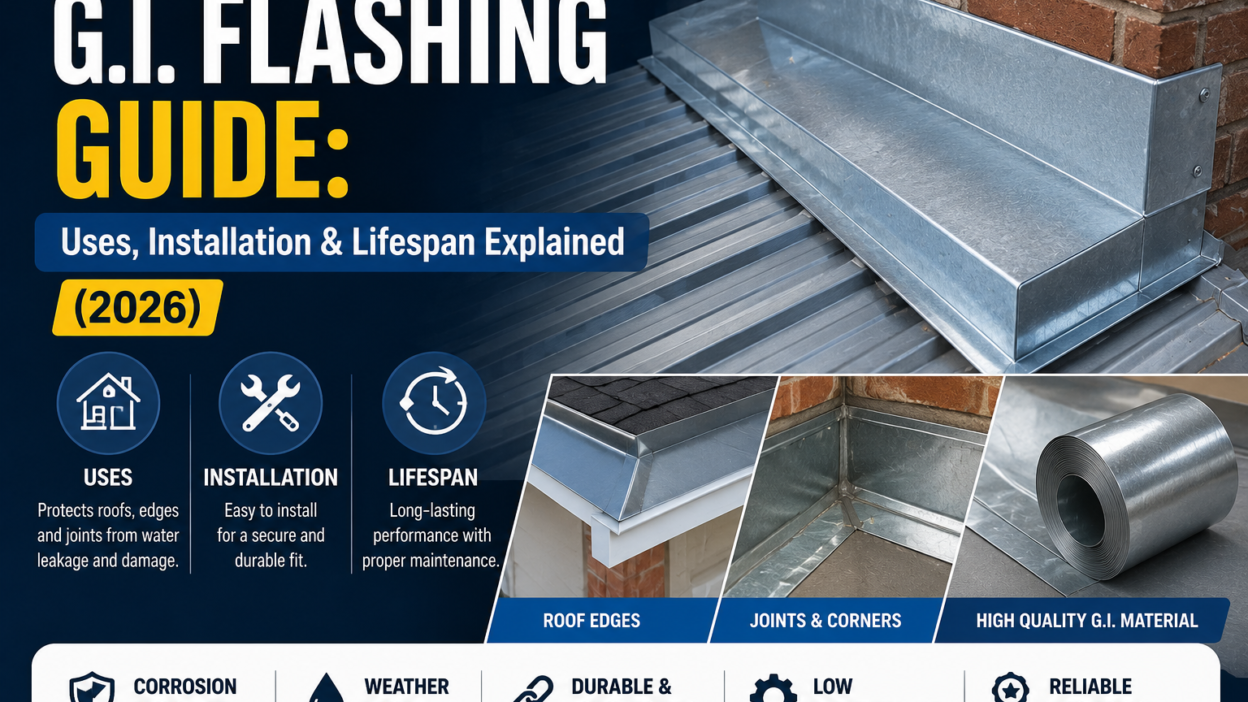
Flashing isn’t just a single item that is installed in a single location. It’s a collection of parts which are all designed for a particular intersection either on the roof or an exterior wall. Step flashing, as an example is installed in separate rectangular pieces that are placed at the spot at which a sloped roof joins the vertical wall. each piece covering the one beneath it as shingles. This creates layers that channel water down rather than sloping towards the walls.
Valley flashing is a part of the inside angle at which two roof slopes join and is a place that takes on a significant portion of water runoff in heavy storms. This is the reason the installers usually use a bigger and heavier thickness of GI sheet here as opposed to elsewhere on the roof. Ridge caps and ridge flashing are used to cover the highest horizontal seam on a roof, securing the point at which two slopes intersect and shielding the nail line beneath from direct exposure to weather. For chimneys, skylights or vent pipes, roofers usually use a base flashing piece with a counter-flashing piece and sandwich the joint in both directions, so that even when water does get past that first layer cannot get to onto the deck of the roof.
Flashing at the corners and barge flashing, also known as gable flashing, safeguard the edges of a roof that extends over a gable wall stopping wind-driven rain from curving under the edges that is the roof material. These components may appear as a minor element on a blueprint for construction and yet omitting even one or installing it in the wrong orientation of overlap allows for direct water to enter.
How G.I. Flashing Is Manufactured
The manufacturing procedure will to explain why not all GI flashing is done in identically regardless of whether two products appear similar on the shelf. The process usually starts with steel coils that have been cold-rolled that are cleansed of the surface oils and then oxidized prior to entering a hot dip galvanizing bath. The steel goes through molten zinc, which is heated to about 400 degrees Celsius and, as the metal emerges, a metallic bond is formed with the zinc on the steel’s surface, forming distinct layers of alloy instead of a single layer that sits on top.
The thickness of this zinc layer determines the length of time the flashing can withstand corrosion prior to rust creeping through. Manufacturers determine this by using a coating class. It is usually described with terms like G60 and G90 according to North American standards, referring to the amount or square feet of coating zinc per. Once galvanized, coils are cut into sizes before being shaped into specific flashing profiles that are required regardless of whether it’s flat sheets for custom fabrication on site or a ridge cap that has been pre-formed and that is folded at a precise angle.
The quality varies significantly between suppliers, and that’s the reason buyers can be taken aback. A zinc coating that is thinner may appear similar to a well coated sheet at the time of installation, however it’ll begin showing streaks of rust in a few days, particularly in areas that are coastal or that are prone to industrial pollution and a high level of industrial pollution, which both increase the rate of corrosion that zinc naturally has.
Comparing G.I. Flashing to Other Common Materials
The choice of the best flashing material isn’t only about cost. The climate, budget roofing design, budget as well as aesthetic preferences are all factors in the selection and various materials are better suited to different climates. The table below shows the way galvanized iron flashing performs against other roofing materials that are frequently used for commercial and residential roofing.
| Material | Average Lifespan | Relative Cost | Best Suited For | Key Drawback |
|---|---|---|---|---|
| Galvanized Iron (GI) | 20-40 years | Low to moderate | General commercial and residential roofing | The zinc coating will eventually become thin and becomes less durable, particularly near beaches |
| Aluminum | 25-40 years | Moderate | Lightweight applications Non-masonry contact | It reacts badly with alkaline and concrete surfaces, unless coated |
| Copper | 50-100plus years | High | Historic or high-end buildings | The initial cost is high, and it will develop a green patina as time passes |
| Stainless Steel | 40-60+ years | High | The coastal or high-corrosion environment | More expensive and more difficult to create on-site |
| Modified Bitumen Tape | 15-25 years old | Low | Additional sealing, code-specific regions such as Florida | Flashing is not a stand-alone solution in all codes |
Galvanized iron is in an enviable middle on this graph, and that’s why it is the preferred option for a lot of projects. It’s not requiring the expensive cost of copper, doesn’t have the issues of masonry compatibility that aluminum has and doesn’t require the specific fabrication skills that stainless steel usually requires. For the typical residential roof that’s not located right on the coast, GI flashing usually delivers the most durable balance of and cost as well as ease of installation. It’s available in the marketplace.
Installing G.I. Flashing the Right Way
Even the most durable flashing material isn’t able to function properly if it’s not installed correctly and this is the reason that most roof leaks are caused and not in the flashing material but rather from inadequate installation. Flashing must be installed to ensure that water flows over the top of every piece and not behind it, forming the roofing term”shingle”-like overlap. Moving this backwards even for a single piece creates a concealed channel that directs water to the roof deck, instead of off of the deck.
Fasteners play a role just as the location. Nailing flashings to both the roof’s plane and to the wall adjacent may appear to create an even stronger hold, but it actually impedes an inevitable expansion or contraction of metal that it experiences as temperatures change. As time passes, this restriction can cause the flashing shrink and warp or tear around the nail point and thereby removing the security it was intended to provide. Professional installers usually secure flashing only to one side, leaving the opposite side to be able to float and move in accordance with temperatures.
Sealants have a role to play as opposed to a principal one. A high-quality roofing cement or sealant will strengthen an overlap in the structure of flashing, but not replace it. Using caulk as the sole component to repair a badly cross-sealed joint is a common method that appears fine when it is installed but fails in a single winter after which the sealant shrinks naturally or cracks, or looses adhesion to UV radiation or freeze-thaw cycles.
Some practical checks are important to keep in mind prior to sign off on any flashing installation
- Make sure that the direction of overlap is in line with the flow of water, with the upper pieces always covering lower ones.
- Make sure fasteners are not double-nailed across 2 different surfaces for expansion
- Verify that the counter-flashing is properly put into masonry joints instead of being caulked on the surface
Maintaining G.I. Flashing Over Time
Galvanized iron requires little maintenance, which is a large part of its appeal. However, just a little bit of regular care can prolong its life substantially. A visual inspection every year is recommended after the most abrasive season that your area experiences detects earlier warning indicators before they turn into structural issues. Be aware of streaks of rust beneath flashing joints. This typically means that the zinc coating is worn off at the exact location and any signs of discontinuity, curly edges and loose fasteners.
The buildup of debris in chimney bases and valleys requires particular attention as leaves and organic matter retain moisture against the surface of the flashing much longer than exposure to sunlight will, leading to the development of corrosion within that particular area while the remainder of the flashing is in good order. Cleaning out this debris every couple of times throughout the year, particularly during the fall months, will do more to prolong the life of flashing than any other maintenance action a homeowner could undertake.
If there is a sign of rust and is not addressed in time, it’s much greater than how large the area affected. A small spot of rust that is identified in the early stages can be dealt by applying a primer that impedes rust and coat of touch-up, whereas the spot that is left untreated for several seasons typically requires replacement of the whole flashing. The roofing industry generally recommends that you have a thorough inspection performed by a certified professional every 5 years, or more. This is because certain indicators of danger, like hairline separation in overlaps are difficult to detect at a distance, or by a casual stroll on the roof’s surface.
Cost Considerations and Long-Term Value
Prices for GI flashing is contingent upon the thickness of the gauge, the coating class, as well as regional cost of materials, however it always ranks as one of the most budget-friendly choices among metal flashing material. If homeowners are looking to compare quotes it’s helpful to ask contractors specifically about the gauge and coating class they are proposing as two bids that use the term “galvanized flashing” can still be significantly different in terms of durability.
The long-term benefit proposition becomes evident when you take into account the amount that a flashing malfunction actually costs. Water infiltration can cause damage to more than the deck of the roof. It could also cause structural framing to rot as well as ruin insulation, cause mold growth, and cause damage to walls and ceilings in the interior before anyone notices the issue, as leaks tend to travel along the framing elements before becoming that is visible. A little bit more upfront cost to get a rated GI flashing installation, carried out by a skilled roofer using proper overlap and fastening methods typically costs less than addressing the consequences of a leak that’s been going on for several years.
Final Thoughts on Choosing G.I. Flashing for Your Roof
G.I. flashing has earned its enduring reputation in the field of roofing because of its genuinely practical combination of low cost, workability and the proven durability. It can handle the most difficult job on any roof, securing the joints and transitions in which the pressure of water is concentrated and does it at a cost that can be used for any project from a modest re-roofing project for your home to a massive commercial construction. The product itself is rarely able to let homeowners down. The reason for problems usually results from installation errors or insufficient zinc coating or a lack of maintenance, rather than any flaw inherent in galvanized iron as a material.
If you’re considering an outdoor roofing project, do not think of flashing as an extra thing to be buried in the contractor’s materials list. Be sure to inquire about the thickness of gauges, coating classes and installation techniques Make sure that the person who is in charge of the project understands the difference between a joint that lets water out and one that allows it into. Make sure you are aware of the details and GI flashing will probably last multiple times of replacement shingle and never cross your mind ever again.
Frequently Asked Questions
What exactly does G.I. mean in G.I. flashing? G.I. means galvanized iron, meaning steel or iron sheet that has been coated with an anti-corrosive layer of zinc to prevent corrosion and rust.
How long will G.I. flashing last? Typically, galvanized iron flashing is between 20 to 40 years, according to how thick the coating of zinc is, the local weather conditions, and also the quality of its installation and maintained over time.
Is G.I. flashing superior to aluminum or aluminum flashing? Both are not universally better than the other. Flashing with GI generally costs less and is able to handle the contact with masonry better while aluminum is lighter but isn’t able to handle alkaline or concrete surfaces, unless properly coated prior to.
Can G.I. flashing be incorporated into the roof of an older structure? Flashing may be incorporated into roof-over construction project, but it is important to evaluate the condition of the current structure first, because flashing will only work properly if it is properly overlapping and bonded into a sound roofing material.
How can I tell whether my flashing requires to be repaired or replaced? Visible rust streaking and curling edges, separated or splintered edges, loose fasteners and water staining walls or ceilings close to the roof joint are indications that flashing must be checked and, if necessary, replaced by a certified roofing expert.