If you’ve come across the NCS S 8010-R10B code when browsing through an illustration chart, preparing an architectural specification or attempting to make a surface match it is some of the darker and least-emphasized colors in the Natural Colour System. This isn’t a color that stands out in a swatch book which is precisely the purpose. NCS S 8010-R10B is an almost black shade with the slightest hint of blue-red that is the type of colors designers look for when they need quality and elegance without committing to black-only. In this tutorial we will explain exactly what this code is and how it works in real-world scenarios and how you can utilize it with confidence whether you’re painting a wall, choosing an item’s finish or a match to the color of an existing surface.
What Does NCS S 8010-R10B Actually Mean
It is the Natural Colour System, developed in Sweden and widely used across Europe to provide industrial and architectural color definition, does not define colors in the same way that paint manufacturers use to do. Instead, it describes precisely the way that a human’s eye perceives the color by using a precise numerical code. This is one of the reasons that professionals in construction, design, and manufacturing depend heavily on it.
The code is broken in pieces simplifies the process. A “S” at the start signifies that the color is part of the NCS Standard collection, the most commonly referenced collection of colors that are part of the system. The first pair of numbers 80 represents blackness in a range of 100 to 0 which means that this color has 80% blackness. This is a very large number, and immediately indicates that it’s a very dark shade, and is more black than any lighter hue. The second pair of numbers 10, which stands for chromaticity that is how much pure vibrant color is available. A 10 chromaticness is quite low, meaning that the color is more muted than vibrant. Then, R10B describes the hue as an underlying shade within the red family, but has it has shifted 10 percent towards blue, resulting in an undertone that is cool rather than a warm hue.
Take all that in Take all of that together, you’ll get NCS S 8010-R10B is an intense color. It is dark, with a low intensity, and has an ethereal hint of a red-blue maroon-black hue. This isn’t a color that you can describe by the terms “red” or “brown” in conversation. Many people who look at it will simply describe it as an intense charcoal or a near-black, with a warm-cool sophistication that is only visible in direct sunlight.
Real-World Color Values for NCS S 8010-R10B
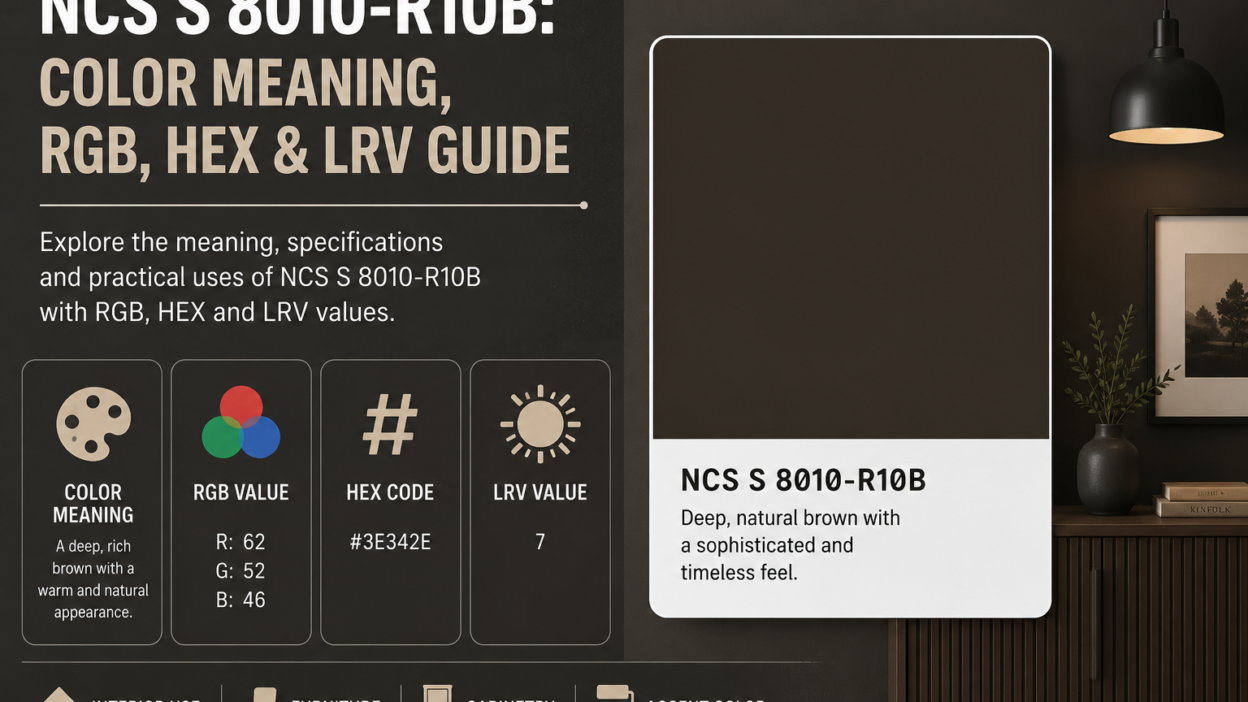
Since NCS is physical spot-color device rather than digital one, translating it precisely to RGB, HEX, or CMYK requires a careful calibration against a color reference that is verified. If properly converted for printing and screen usage, NCS S 8010-R10B corresponds to an RGB value of 54 31, 35. This is converted to an HEX code of 361F23. This confirms the blackness and chromaticity numbers suggested previously as a very dark and somewhat cool-leaning, near-black.
The most valuable technical statistics associated with an NCS color is its Light Reflectance value often abbreviated as LRV. The LRV number is a measure of the amount of visible light a color is able to reflect, ranging from 0 which is theoretically pure black, at 100 which represents pure white. NCS S 8010-R10B has an LRV of approximately 1.9 which is a remarkably low value that puts it in the same neighborhood of reflectance as blacks that are true. To give you an idea, the majority of standard black paints have an LRV between 1 and 5, which means that the color appears visually exactly like black in all lighting conditions. It differentiates its own color only by subtle undertone shifts if you look in close proximity or under intense direct lighting.
NCS S 8010-R10B Technical Reference Table
The table below summarises the most important characteristics of this color. This is helpful for anyone who works with digital, print, and physical matchups.
| Property | Value | What It Means |
|---|---|---|
| NCS Notation | S 8010-R10B | Standard NCS second edition code |
| Blackness | 80% | Very high, which indicates an almost black shade |
| Chromaticness | 10% | A muted, low-saturation and subdued tone |
| Hue | R10B | Red hue shifted 10% toward blue |
| Approximate RGB | 54, 31, 35 | Digital screen equivalent |
| Approximate HEX | #361F23 | Software for Web design and web codes |
| Light Reflectance Value (LRV) | ~1.9 | Visually, it appears as black |
| Approximate CMYK | 0, 45, 36, 77 | Print reference, which varies according to printer calibration |
Why the NCS System Matters for Accurate Color Matching
Anyone who’s tried to reproduce a color with just a photograph or screen display understands the degree of uncertainty that this method can be. Screens differ in terms of brightness, calibration and color rendering. This means that the identical HEX code may appear different from one display in comparison to another. The NCS system can solve this problem by securing every color to a physical uniform sample, not the digital data alone. That’s why people working using NCS S 8010-R10B, be it in product design, architecture or automotive finishing are strongly urged to use the physical NCS shader or validated sample, rather than relying on a screen-based preview.
This is especially true when it comes to a color like S 8010-R10B since close-black shades are especially sensitive to light circumstances and the screen’s calibration. This dark shade may appear to be shifting between a neutral charcoal or the appearance of a slight maroon-black, depending on the lighting in the room, the quality of the surface and even the time of the day. The use of a certified NCS sample eliminates the uncertainty and guarantees the sameness across projects particularly when several suppliers, contractors or design teams have to use the same shade.
Where NCS S 8010-R10B Works Best
Due to its low reflectance and subdued shade, NCS S8010-R10B is a great choice for situations where a black-like color is desired, however a boring, uninteresting black could seem too harsh or one-dimensional. In interior and architectural design work the color is typically used for accent windows, cabinets, wall frames and trim details. designers desire the visual weight of black with a hint of warmth to keep the shade from feeling dull or sterile.
For outdoor applications, deep low-chroma, low-chroma shades like this one are often utilized for doors as well as fascia boards and metal detailing. The close to black tone offers a strong visual contrast with lighter siding or masonry, without the problems that maintenance-free black coatings may present like visible fade or chalking with time. Because the chromatic strength is low, this color can be easily paired with a broad spectrum of other shades that range from warm neutrals wood finishes, to cooler whites and grays as its subtle undertone doesn’t compete with other shades.
Manufacturers and designers also prefer colors from this spectrum for products in which the appearance of a high-end, minimalist appearance is important, like automotive trim, consumer electronics and furniture hardware of high-end quality. The subtle red-blue undertone provides the finish some visual depth when exposed to the raking light than the neutral black color which is typically the subtle distinction that a design brief requires.
How to Specify and Order NCS S 8010-R10B Accurately
If you’re looking to get this color matched to be used in a real-world project, whether it’s exterior coating, interior paint or a custom finish, precision is important. Many professional and industrial paint manufacturers provide NCS colour matching solutions which will create the perfect mix, that is specifically calibrated according to the S 8010-R10B notation instead of using the estimated RGB as well as HEX conversion. This is the best option if accuracy in color is crucial to your project especially for large-scale projects in which multiple batches must be matched precisely.
When you place an order, it is helpful to mention not only the NCS code as well as the finish and material you’re working with, because the sheen level has a significant impact on the way the dark, low-chroma shade such as this appears in real life. A flat or matte finish will enhance the color’s near-black depth and eliminate any obvious undertones. On the other hand, the gloss or satin finishes will reflect more light and show the subtle red-blue hue more clearly, particularly from certain angles of view. If your project involves several materials, like painted trim or powder-coated railing made of metal, requesting the samples for both prior to making a final decision on a complete order is a good way to detect any differences earlier.
For those who order smaller quantities, many specialist paint stores now offer customized color matching for spray paints bottle, touch-up bottles and small-batch acrylics that are specifically designed to NCS notations and making it more convenient than ever for hobbyists restorers and small project owners to obtain precise color matching without having to buy industrial quantities.
Common Mistakes to Avoid When Working With This Color
One of the most common mistakes made by people with the dark color is to assume that it reads similarly to normal black paint. They are amazed when it appears different in certain lighting conditions. Since the LRV is positioned just above black and not at a zero level, slight variations in light sources such as warm incandescent lamps as well as cool LEDs can alter the way in which an undertone is. It’s worth testing an example patch under the lighting conditions of your final space prior to making the full-on application.
A different issue is when individuals attempt to reproduce this color solely by using the internet for an HEX or RGB conversion instead of an actual NCS sample. Conversions to digital format of NCS colors are merely approximates, and, while they can be useful in the early stages of visualization however, they’re not an alternative to physically-calibrated match-ups, particularly in commercial or professional projects in which consistency across areas and batches is vital.
Wrapping Up
NCS S 8010-R10B, a shade that was designed to convey subtlety and aplomb rather than a bold look. Its high blackness as well as its low chromaticity and a subtle red-blue undertone to create a shade that appears elegant and grounded, rather than sharp or flat. It doesn’t matter if you’re using it for architectural trimming, product finishes, or for a specific paint color match knowing exactly what the notation means and its actual RGB, HEX, and LRV values, will give an assurance that you can work with this color with accuracy and consistency for every design. Like any color that is this dark and complex working with a certified real-world sample rather than an image preview on a screen is the best way to ensure the most precise outcome.
Frequently Asked Questions
What colour family is NCS S 8010-R10B belonged to? It belongs to the family of hues that comprise red in the NCS system, which is shifted 10 percent to blue, however, because its blackness is high, at a rate of around 80 percent it is read visually as a blackish shade instead of the true red or brown.
Does NCS S 8010-R10B as good with the pure black? No, though it’s very similar. The Light Reflectance value of 1.9 is just above the theoretical black. Additionally, it has a subtle red-blue undertone, which is apparent under certain lighting conditions in contrast to a pure black.
Do I have the ability to make a match to NCS S 8010-R10B by using only an HEX number? You can get an approximation of a reasonable visual with 361F23 HEX code 361F23 however, for commercial or professional projects, it’s best to purchase a certified NCS colour match through a paint vendor to ensure that the color matches are accurate across a variety of types of lighting and surfaces.
What kinds of finishes will work best with this shade? Matte and flat finishes tend to highlight the black-like depth of this shade. On the other hand, gloss or satin finishes show more of its subtle red-blue undertone especially when exposed to direct or angled lighting.
Which places is NCS S 8010-R10B used most often? It is frequently used for architectural trims doors, door frames, cabinetry and metal detail and products finishes for automotive trim and furniture hardware in cases where a sophisticated black shade is preferred over simple pure black.