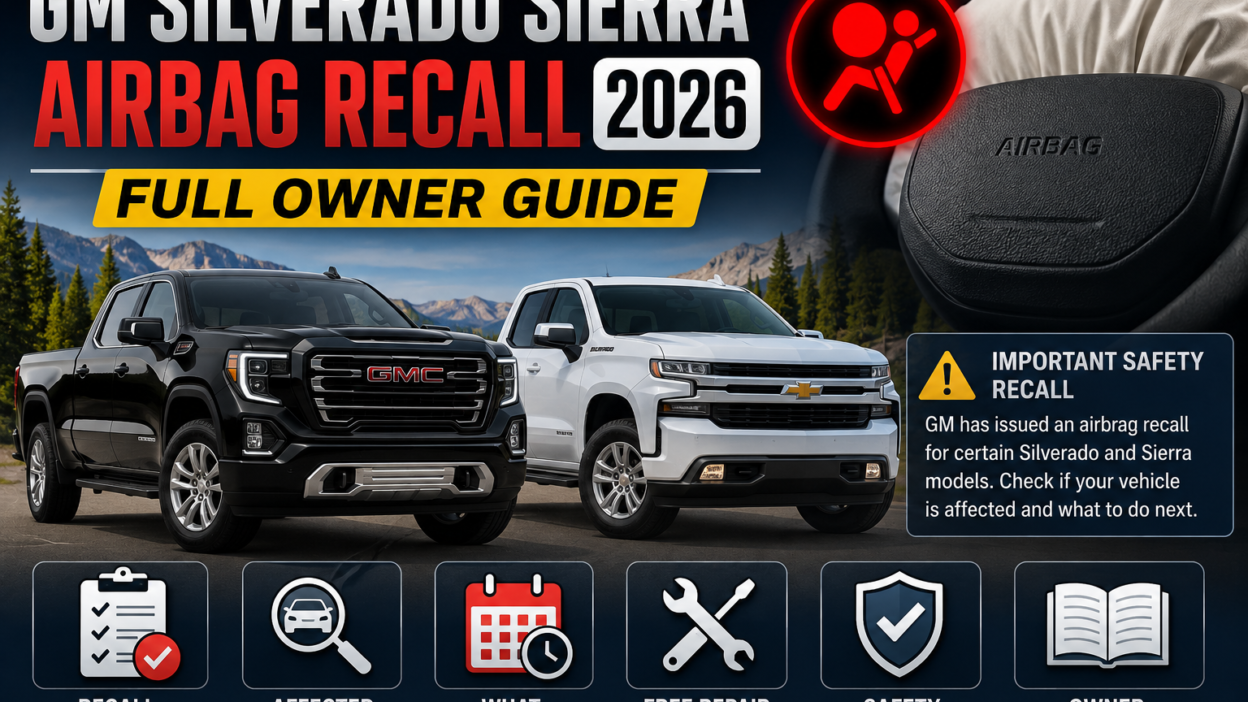
If you own an Chevy Silverado model or GMC Sierra built in 2018 or 2019 then there’s a high chance that you’ve heard rumours of a new safety warning that’s been spotted in mailboxes across the nation. This GM Silverado Sierra airbag recall has been among the top talked about truck safety news of this year, and with the right reasons. A defect in the roof rail airbag system could be a problem in a few cases. It could cause the inflator to break or cause the cap’s end to fall off, releasing debris into the cabin, instead of protecting the passengers inside. This isn’t a minor technical issue. This is the kind of defect that can turn a safety function to a danger.
This guide explains the specifics of what’s happening what it is, why it’s important and which trucks are affected and what you must do should the model you own, Silverado or Sierra is included in the population of recalls. We’ll also discuss the impact of this recall compared to the previous GM recalls as well as what the repair process is actually like and how to ensure that nothing goes wrong before the truck is repaired. It doesn’t matter if you bought an old Silverado in the last month, or have had the Sierra since it left from the yard, it article is worth 10 seconds of time.
What Triggered the GM Silverado Sierra Airbag Recall
Every recall begins somewhere and this recall began with a few unsettling reports, rather than a lab test that went wrong. In the early 2026 time frame an individual complained to GM that the roof rail on the right side of the airbag of an unattended vehicle in the year 2018 Silverado 1500 had ruptured with no warning, and there was there was no crash was involved. Then, a few months later the same incident occurred in a model from 2019, also while the truck was without a driver in a driveway. The photos from the second incident included a damaged inflator end cap, as well as damaged headliner and roof structure. It is a sure sign that the module was failing physically under pressure.
The GM engineers traced both instances back to a single source, Joyson Safety Systems, specifically to the modules made using a specific lot of production. Airbags on the roof are tucked away between those windows that are on either side of the car and are designed to open down in the event of a collision with a severe or a rollover to protect necks and heads from hitting the frame of the window and flying particles. If the inflator within one of these modules functions correctly, it’s a life-saving device of engineering. If it’s not working then the same compressed gas and metal parts that are intended to safeguard occupants could be a source of danger.
The reason for the issue turned out to be rather simple. In the course of manufacturing, certain canisters of inflators absorbed small amounts of water from washing steps in the manufacturing line. In a housing made of metal, sealed in constant tension, this water can cause what engineers call stress corrosion cracking. Imagine a wire that has been bent repeatedly. It won’t snap upon the first bend, but tiny cracks develop invisibly until it eventually is all broken. This is the way it happens inside the inflator’s canister that’s damaged however the point of failure is caused by gas pressure inside the canister instead of mechanical flexible.
How the Recall Has Expanded Since Early 2026
It’s not GM’s first attempt to address the issue. In March 2026, the automaker announced a first more limited recall of 28819 trucks across the country after identifying the initial suspected production site. The time was when GM thought the problem was restricted to the specific batch. However, as engineers dug into the supplier’s records they discovered that the same defect was present in additional inflators, which weren’t included in the initial notice.
This led to the increased 2026 campaign, which will add another 2,785 truck models to its list of vehicles, bringing the total amount of both recalls to about 5,600 vehicles. It’s an excellent illustration of how recalls in the automotive industry tend to be handled in phases rather than in a single, sweeping. Manufacturers often begin with conservative approaches according to the data currently available and but broaden the scope when further tests or additional field reports indicate a larger pattern. If you’re the owner of an 2018 or 2019 Silverado or Sierra and you didn’t receive notice of the issue during the first quarter of 2019, it’s worth checking now, as your vehicle could be swept up in this second wave even though it wasn’t in the initial.
Which Trucks Are Actually Affected
The population of recalls covers the entire GM full-size truck line-up and not only the basic half-ton models. In addition, the Chevrolet Silverado and its mechanically closely related sibling, GMC Sierra, are included as well as the affected series. They ranges from the lighter-duty 1500 up to the more heavy-duty 2500HD and the 3500HD. The trucks were built on the K2XX platform of GM’s earlier model that was the basis for Silverado as well as Sierra production prior to the new generation T1XX technology took over.
The combination of transmission and engine doesn’t affect which truck is affected. The trucks that have naturally-aspirated V6 Vortec 6000 gas engine as well as the Duramax diesel could all be part of the recall population as the issue is in the airbag unit instead of anything related with the drivetrain. What determines whether your vehicle requires the correction is the number of production lots connected to its particular inflator. This is the reason making sure you check the VIN directly is much more reliable than just looking at the year of manufacture.
Understanding the Real Safety Risk
It’s simple to look up “airbag recall” and picture an abstract concept, so let’s talk about what can actually occur. Roof-rail airbags are classified as supplemental restraint devices. They are used in conjunction with seatbelts and frontal airbags instead of replacing them. In the event of a rollover or serious collision with a side the module is deployed downwards within a fraction of a second creating an air cushion between the person’s head as well as the hard surface of the door’s frame and window.
If the cap of an inflator breaks off during that split second deployment the compressed gas within may escape in a different way and metal fragments that escape that escape from the canister themselves could be released into the cabin. In a collision scenario it’s a risk. However, GM’s investigation revealed something that could be more alarming: both incidents thus far occurred when the trucks were parked totally stationary, without collision and no deployment instructions and with no warning whatsoever. This suggests that this isn’t solely a crash-dynamics problem. A damaged canister could fail because of their own pressure for a long time. That’s the reason GM took the decision to move fast rather than wait for field information to build up.
To understand the context It’s helpful to compare the present situation with GM’s most well-known previous airbag-related issue.
| Comparison Point | 2026 Roof-Rail Airbag Recall | Prior Takata-Related Recalls |
|---|---|---|
| Root cause | Manufacturing stresses corrosion, cracking of stress | Propellant degradation with time and exposure to humidity |
| Supplier | Joyson Safety Systems | Takata Corporation |
| Affected component | Roof-rail side-curtain airbag inflator | Frontal airbags for the driver and passenger inflators |
| Scope | About five thousand vehicles (combined waves) | Many millions of cars in the entire industry |
| Incidents that have been reported | Two ruptures have been identified, there are no injuries that can be confirmed. | Numerous fatalities and injuries from a variety of automakers |
| Repair | Free module replacement | Replacement of the inflator for free |
This is important because it helps put the magnitude of the recall into the proper perspective. The recall is an extremely serious issue that requires immediate attention, however, it’s a vastly distinct and more tightly controlled circumstance than the widespread Takata issue that made the news for the last part of the past decade.
What GM Is Doing to Fix the Problem
The positive side is that GM’s solution is simple and free for the owners. Dealers will replace both left and right roof rail airbags with brand new units that are sourced from production runs which are outside of the time frame that is suspect. There’s no diagnostic cost and no charge for parts, and no cost for labor transferred to the customer. The majority of technicians can finish the repair within a matter of minutes after the vehicle is mounted on a lift. So this isn’t the type of repair that will bind your vehicle for a long time.
The recall has been carried out in the usual recall timeline. Dealers were informed of the extended recall in the month of May, which gave service departments the opportunity to purchase the appropriate replacement parts and plan their schedule. GM started sending physical notifications to owners who have registered and all affected customers being expected to receive a letter before the end of July 2026. The timing of the mail isn’t always reliable however, particularly when it comes to trucks that changed ownership after their purchase and therefore waiting to receive a notification letter isn’t the most efficient method.
How to Check If Your Truck Is Affected
The process of confirming your truck’s status can take only a couple of minutes and you don’t have to wait for a letter to confirm it. The number that identifies your vehicle which is a 17-character code that’s normally visible on the windshield, on one side, which is the drivers is the way to gain access to this information immediately.
You can look it up in any of these resources:
- The Chevrolet’s official recall tool is available at Chevrolet.com
- GMC’s official recall search tool is available at GMC.com
- Search for recalls by the National Highway Traffic Safety Administration is available at NHTSA.gov that covers all recalls that are open across all automakers in one location
Inputting your VIN into one of these programs will inform you right away if your vehicle is included in this recall or other recall that GM currently has in force. It’s a good habit to build over the course of time, even after this particular issue, because the status of recalls can alter as automakers expand or modify existing campaigns.
What Owners Should Do Right Now
If you’re Silverado or Sierra is found to be affected then the next step is easy: contact your local GM dealership to schedule the repair for free. Do not be apprehensive about having to wait for the actual notice to come in before arranging an appointment. Dealers are able to look up your VIN and verify eligibility immediately. Also, getting on the schedule earlier often results in shorter wait times prior to the repair date.
As you wait to see your doctor, there’s not a reason to be anxious or avoid driving your truck at all costs. GM hasn’t yet issued a do not drive notice for this recall which is a classification reserved for any defects that are serious enough to warrant the need to park the vehicle in a hurry. It’s still sensible to be cautious, especially in the case of people in your back of your vehicle with airbags on the roof, which offer the greatest security. It is better to fix the problem sooner instead of later is the wise choice, especially for families that use these trucks for regular driving, not just occasional transporting.
Owners who’ve experienced rupture, sustained property damages, or had difficult times having their dealer honor the repair they offered must keep a record of everything, including photographs of repair orders, repairs, and all correspondence. This paper trail is important in the event that you need to file a claim or escalate an issue you are not able to resolve in a dispute with GM directly.
Why This Recall Matters Beyond Just These Trucks
There’s an important lesson in this tale that is applicable to all who own any vehicle, no matter the its model or make. Manufacturing flaws like this seldom surface in the initial few years in the open road. Cracking caused by stress corrosion, due to its nature, progresses slowly so a car is able to run perfectly for a long time before a defect finally shows up. This is why keeping track of recall notifications is essential when vehicles are solid from every day.
It’s also important to note that recalls aren’t an indication of failure in the automobile, but rather as a reflection of the safety system functioning in the way it was intended. GM recognized a pattern in only two field reports, and then decided to tackle it in a proactive manner rather than wait for a better result. Compare that responsiveness with the way safety concerns in automobiles were handled in the past and you can see how much more firmly manufacturers are now taking early warning signs, partially because of stricter NHTSA supervision and also due to the legal and reputational consequences that automakers have suffered from the past recalls.
Final Thoughts on the GM Silverado Sierra Airbag Recall
This GM Silverado Sierra airbag recall is a distinct significant safety issue that affects the model years 2018 and 2019. trucks in the 1500 to 3500 series. The root of the issue is traced back to the manufacturing of moisture in roof rail airbag inflators made through Joyson Safety Systems, which could lead to end cap detachment, or in a few cases, complete sidewall tear. GM responds by extending its March 2026 recall to bring the total to approximately 5,600 trucks. The company will replace every affected module for free.
If you have one of the Silverado or Sierra from the model years of these do not wait for a letter that will show at your door. Make sure you check for your VIN by using Chevrolet, GMC, or the NHTSA’s recall database and if the truck is back flagged, contact your dealer to get the recall scheduled. It’s not expensive and takes less than an hour at the repair shop, and then closes the door to a problem that shouldn’t be over your head each when you travel.
Frequently Asked Questions
Which years will be affected by GM Silverado Sierra airbag recall? The recall covers the 2018 and 2019 model years of Chevrolet Silverado and GMC Sierra trucks. It covers the 2500HD, 1500, and 3500HD series.
What can I do to determine whether my particular vehicle is part of this recall? Enter your 17-character VIN into GMC’s or Chevrolet’s Official recall search engine or search directly in the database of recalls at NHTSA.gov. This will verify your truck’s status right away.
Will GM cost me anything for airbag repairs? No. GM will cover the entire cost of the parts and labor in this recall. Dealers replace the roof rail airbag module with new units for free to the customer.
Do I have to drive my vehicle while waiting until the fix is completed? GM has not issued a no-drive warning in connection with this recall, therefore driving is generally safe. However it is important to schedule the repair as soon as possible. is a wise choice particularly if you regularly take passengers.
Do you think this is the same defect that caused in the Takata airbag recalls? No. The recall is caused by manufacturing cracks and moisture in the inflators manufactured through Joyson Safety Systems, which is a distinct cause with is much less extensive as the propellant degradation issues that led to the widespread Takata recalls.